

After a year of increasingly dire warnings about the imminent demise of humanity at the hands of superintelligent artificial intelligence (AI), Magazine is in Panama at the Beneficial AGI Conference to hear the other side of the story.
Attendees include an eclectic mix of transhumanists, crypto folk, sci-fi authors including David Brin, futurists and academics.
The conference is run by SingularityNET, a key member of the proposed new Artificial Superintelligence Alliance, to find out what happens if everything goes right with creating artificial general intelligence (AGI) — human-level, artificial general intelligence.
But how do we bring about that future, rather than the scenario in which Skynet goes rogue and kills us all?
One of the best insights into why those questions are so important comes from futurist Jose Luis Cordeiro, author of The Death of Death, who believes humanity will cure all diseases and aging thanks to AGI.
He tells Magazine of some sage wisdom that Arthur C. Clarke, the author of 2001: A Space Odyssey, once told him.
He said: ‘We have to be positive about the future because the images of the future — of what’s possible — begin with our minds. If we think we will self-destroy, most likely we will. But if we think that we will survive, [that] we will move into a better world [then we] will work toward that and we will achieve it.’ So it begins in our minds.”

Beneficial AGI: The quest for artificial general intelligence
Humans are hardwired to focus more on the existential threats from AGI than on the benefits.
Evolutionary speaking, it’s better that our species worries nine times too often that the wind rustling in the bushes could be a tiger than it is to be blithely unconcerned about the rustling and get eaten by a tiger on the 10th occurrence.
Even the doomers don’t put a high percentage chance of AGI killing us all, with a survey of almost 3000 AI researchers suggesting the chance of an extremely bad outcome ranges from around 5% to 10%. So while that’s worryingly high, the odds are still in our favor.
Opening the conference, SingularityNET founder and the “Father of AGI,” Dr. Ben Goertzel, paid tribute to Ethereum founder Vitalik Buterin’s concept of defensive accelerationism. That’s the midpoint between the effective accelerationism techno-optimists and their “move fast and break things” ethos, and the decelerationists, who want to slow down or halt the galloping pace of AI development.
Goertzel believes that deceleration is impossible but concedes there’s a small chance things could go horribly wrong with AGI. So he’s in favor of pursuing AGI while being mindful of the potential dangers. Like many in the AI/crypto field, he believes the solution is open-sourcing the technology and decentralizing the hardware and governance.

What is the Artificial Superintelligence Alliance?
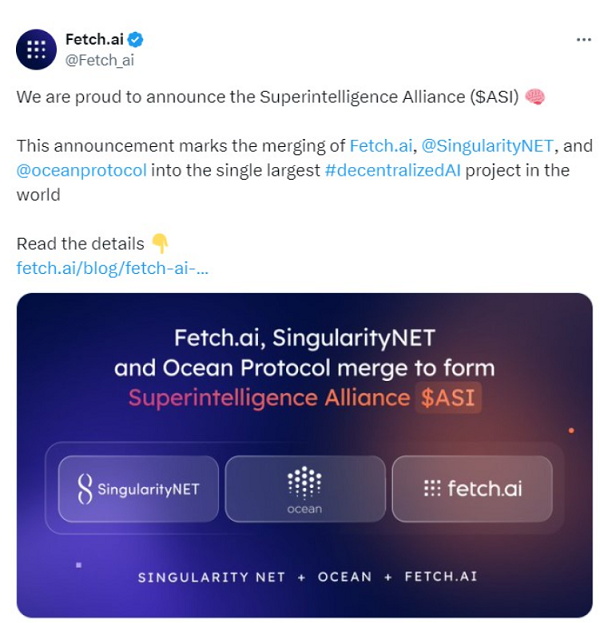
This week SingularityNET announced it has teamed up with the decentralized multi-agent platform FetchAI — founded by DeepMind veteran Humayun Sheikh — and the data exchange platform Ocean Protocol to form the Artificial Superintelligence Alliance (ASI).
It will be the largest open-sourced independent player in AI research and development and has proposed merging SingularityNET, FetchAI and Ocean Protocol’s existing tokens into a new one called ASI. It would have a fully diluted market cap of around $7.5 billion — subject to approval votes over the next two weeks. The three platforms would continue to operate as separate entities under the guidance of Goertzel, with Sheikh as chair.
According to the Alliance, the aim is to “create a powerful compelling alternative to Big Tech’s control over AI development, use and monetization” by creating decentralized AI infrastructure at scale and accelerating investment into blockchain-based AGI.
What are the benefits of AGI?
Probably the most obvious beneficial impact is AGI’s potential to analyze huge swathes of data to help solve many of our most difficult scientific, environmental, social and medical issues.
We’ve already seen some amazing medical breakthroughs, with MIT researchers using AI models to evaluate tens of thousands of potential chemical compounds and discovered the first new class of antibiotics in 60 years, one that’s effective against the hitherto drug-resistant MRSA bacteria. It’s the sort of scaling up of research that’s almost impossible for humans to achieve.
And that’s all before we get to the immortality and mind-uploading stuff that the transhumanists get very excited about but which weirds most people out.
This ability to analyze great swathes of data also suggests the technology will be able to give early warnings of pandemics, natural disasters and environmental issues. AI and AGI also have the potential to free humans from drudgery and repetitive work, from coding to customer service help desks.
While this will cause a massive upheaval to the workforce, the invention of washing machines and Amazon’s online businesses had big impacts on particular occupations. The hope is that a bunch of new jobs will be created instead.
Economic professor Robin Hanson says this has happened over the past two decades, even though people were very concerned at the turn of the century that automation would replace workers.
Hanson’s study of the data on how automation impacted wages and employment across various industries between 1999 and 2019 found that despite big changes, most people still had jobs and were paid pretty much the same.
“On average, there wasn’t a net effect on wages or jobs in automation of U.S. jobs from 1999 to 2018,” he says.
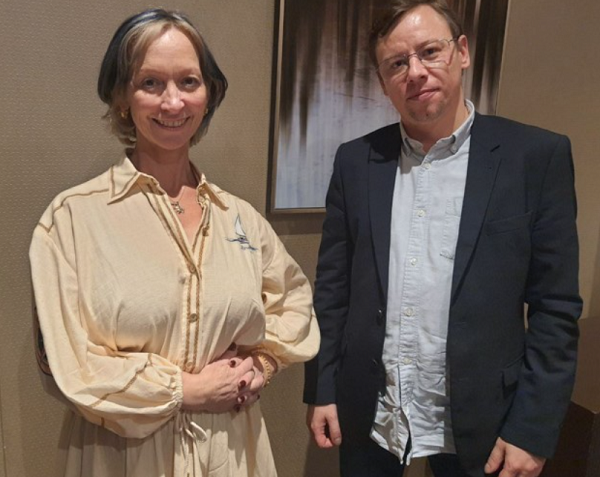
AGI could make better decisions than we can: SingularityNET COO Janet Adams
Janet Adams, the optimistic COO of SingularityNET, explains that AGI has the potential to be “extraordinarily positive for all humanity.”
“I see a future in which our future AGIs are making decisions which are more ethical than the decisions which humans make. And they can do that because they don’t have emotions or jealousy or greed or hidden agendas,” she says.
Adams points out that 25,000 people die every day from hunger, even as people in rich countries throw away mountains of food. It’s a problem that could be solved by “intelligent allocation of resources across the planet,” she says.
But Adams warns AGI needs to be trained on data sets reflecting the entire world’s population and not just the top 1% so that when they make decisions, “they won’t make them just for the benefit of the powerful few, they will make them for the benefit of the broader civilization, broader humanity.”
AI safety and ethics: Addressing the concerns
Anyone who watched the early utopian dreams of a decentralized internet crumble into a corporate ad-filled landscape of addictive design and engagement farming may have doubts this rosy future is possible.
Building high-end AI requires a mountain of computing and other resources that are currently out of reach of all but a handful of the usual suspects: Nvidia, Google, Meta and Microsoft. So the default assumption is that one of these tech giants will end up controlling AGI.
Goertzel, a long-haired hippy who plays in a surprisingly good band fronted by a robot, wants to challenge that assumption.
Goertzel points out that the default assumption used to be that companies like IBM would win the computing industry and Yahoo would win search.
A tattered copy of The Prometheus Project
A tattered copy of The Prometheus Project. (Source: Internet Archive)
“The reason these things change is because people were concretely fighting to change it in each instance,” he says. “Instead, Bill Gates, Steve Jobs and the Google guys came along.”
The founder of SingularityNET, he’s been thinking about the Singularity (a theoretical moment when technological development increases exponentially) since the early 1970s when he read an early book on the subject called The Prometheus Project.
He’s been working on AGI for much of the time since then, popularizing the term AGI and launching the OpenCog AI framework in 2008.
Adams says Goertzel is a key reason SingularityNET has a credible shot.
“We are the biggest not-for-profit, crypto-funded AI science and research team on the planet,” Adams says, noting their competitors have been focused on “narrow AIs” like ChatGPT and are only now shifting their strategy to AGI.
“They’re years behind us,” she says. “We have three decades of research with Dr. Ben Goertzel in neural symbolic methods.”
But she adds that opening up the platform to any and all developers around the world and rewarding them for their contribution will give it the edge even over the mega-corporations who currently dominate the space.
“Because we have a powerful vision and a powerful commitment to building the most advanced, most intelligent AGI in a democratic way, it’s hard to imagine that Big Tech or any other player could come in and compete, particularly when you’re up against open source.”
“[We will] see a potentially huge influx of people developing on the SingularityNET marketplace and the continued escalation of pace toward AGI. There’s a good chance it will be us.”
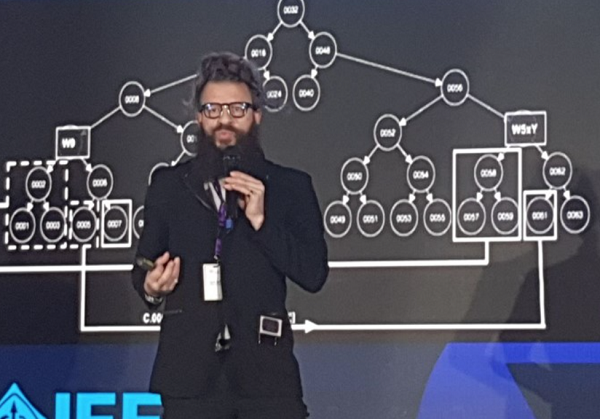
Decentralized AI: Opening the door to open source development
The Prometheus Project proposed that AI was such an earth-shattering development that everyone in the world should get a democratic vote on its development.
So when blockchain emerged, it seemed like implementing decentralized infrastructure and token-based governance for AI was the next most practical alternative.
HyperCycle CEO Toufi Saliba tells Magazine this mitigates the threat of a centralized company or authoritarian country gaining immense power from developing AGI first, which would be “the worst thing that ever happened to humanity.”
It’s not the only potential solution to the problem. Meta chief AI scientist Yan Le Cun is a big proponent of open-sourcing AI models and letting a thousand flowers bloom, while X owner Elon Musk recently open-sourced the model for Grok.
But blockchain is arguably a big step up. SingularityNET aims to network the technology around the world, with different components controlled by different communities, thereby spreading the risk of any single company, group or government controlling the AGI.
“So you could use these infrastructures to implement decentralized deep neural networks, you could use them to implement a huge logic engine, you can use them to implement an artificial life approach where you have a simulated ecosystem and a bunch of little artificial animals interacting and trying to evolve toward intelligence,” explains Goertzel.
I want to foster creative contributions from everywhere, and it may be some, you know, 12-year-old genius from Tajikistan comes up with a new artificial life innovation that provides a breakthrough to AGI.”
What is HyperCycle? What is OpenCog Hyperon?
HyperCycle is a ledgerless blockchain that’s fast enough to allow AI components to communicate, coordinate and transact to finality in under 300 milliseconds. The idea is to give AIs a way to call on the resources of other AIs, paid for via microtransactions.
For now, the fledgling network is being used for small-scale applications, like an AI app calling on another AI service to help complete a task. But in time, as the network scales, it’s theoretically possible that AGI might be an emergent property of the various AI components working together in a sort of distributed brain.
“So, in that approach, the entire world has a much higher chance to get to AGI as a single entity,” Saliba says.
Goertzel didn’t develop HyperCycle for that reason — he just needed something miles faster than existing blockchains to enable AIs to work together.
The project he’s most excited about is OpenCog Hyperon, which launches in alpha this month. It “combines together deep neural nets, logic engines, evolutionary learning and other AI paradigms in the same software framework, for updating the same extremely decentralized Knowledge Graph.”
The idea is to throw open the doors to anyone who wants to work on it in the hope they can improve the METTA AGI programming language so it can scale up massively. “We will have the complete toolset for building the baby AGI,” he says. “To get something I would want to call it baby AGI we will need that million times speed up of the METTA interpreter,” he says.
“My own best guess is that Opencog Hyperon may be the system to make the [AGI] breakthrough.”
AI governance: The role of voting systems
Of course, decentralization does not ensure things will go right with AGI. As Goertzel points out, the government of Somalia was decentralized very widely in the 1990s under a bunch of warlords and militias, but it would have been preferable at the time to live under the centralized government of Finland.
Furthermore, token-based governance is a long way from being fit for prime time. In projects like Uniswap and Maker, large holders like a16z and the core team have so many tokens it’s almost not worth anyone else voting. Many other decentralized autonomous organizations are wracked by politics and infighting.
The surging price of crypto/AI projects has attracted a bunch of token speculators. Are these really the people we want to put in control of AGI?
Goertzel argues that while blockchain projects are currently primarily attractive to people interested in making money, that will change as the use case evolves.
“If we roll out the world’s smartest AI on decentralized networks, you will get a lot of other people involved who are not primarily oriented toward financial speculation. And then it’ll be a different culture.”
But if the Artificial Superintelligence Alliance does achieve AGI, wouldn’t its tokens be ludicrously expensive and out of reach of those primarily interested in beneficial AGI?
Goetzel suggests that perhaps a weighted voting system that prioritizes those who have contributed to the project may be required:
“I think for guiding the mind of the AGI, we want to roll out a fairly sophisticated, decentralized reputation system and have something closer to one person, one vote, but where people who have some track record of contributing to the AI network and making some sense, get a higher weighting.”


All Comments