


From ledgerinsights by Ledger Insights
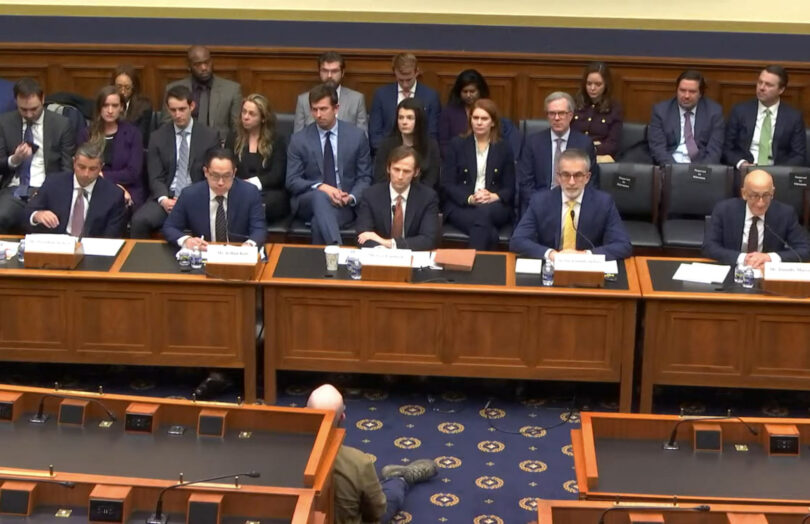
Yesterday the House Financial Services digital asset subcommittee held a hearing on charting a path forward on digital assets. There’s a consensus that stablecoin legislation is urgent, with multiple Bills circulating. However, there’s also a need for legislation around market infrastructure, including regulating crypto exchanges. Last year the House passed the FIT 21 Bill, but there was less progress in the Senate. One of the topics discussed during the hearing was whether the SEC could provide a solution in the interim.
A takeaway from the hearing is a lightweight alternative to a full crypto infrastructure Bill such as f FIT 21. For now legislation may only be needed to make the CFTC the regulator of spot crypto commodity markets. The steps might involve:
- Delegating authority to regulate spot crypto to the CFTC via legislation
- Creating a self regulatory organization (SRO) jointly overseen by the CFTC and SEC which would set rules for crypto exchanges and the like
- The SEC clarifies rules on when a digital asset is a security or not
- The SEC creates some new exemption(s) for digital asset issuers
- And all the other items on the list recently proposed by SEC Commissioner Peirce.
Even if that’s not the long term solution, it might be the fastest interim one.
Regulatory exemptions
Congressman Hill asked Coy Garrison about the various SEC exemptions currently used for issuing digital assets. Mr Garrison previously served as counsel to SEC Commissioner Hester Peirce. The lawyer explained that many issuers use Regulation S, which restricts the asset to offshore investors. Those willing to target US investors often use Regulation D, which means assets are only available to wealthy investors.
“What I think the ecosystem has to understand is that not all these needed activities can be taken care of by the Commission by itself without Congress,” said Congressman Hill. And he asked what sort of exemption system the SEC could add without Congress.
Mr Garrison suggested something similar to Commissioner Peirce’s Safe Harbor provisions, which would allow access to retail investors. Last week Commissioner Peirce mentioned reviewing Regulation A and crowdfunding rules. Additionally, Mr Garrison noted that disclosure requirements could be tailored, as token holders have different interests compared to shareholders who need financial statements, which he clarified in his written testimony. He noted that many provisions from other exemptions could be used, including limits on the number of investors and the proportion of a person’s net worth that can be invested.
Another witness, former CFTC Chair Timothy Massad, is keen for the SEC to take a first pass, rather than Congress. He highlighted that the SEC only needs the three votes of its Republican Commissioners, compared to 60 Senate votes.
“I have confidence that they (the SEC) can come up with some interesting ideas, but this is a very difficult issue to address. And I’m worried that if Congress tries to do it, we’ll undermine our Securities markets,” said Mr Massad. He was responding to questions from Congressman Haridopolos, who observed that the challenge with leaving it all to the regulators is that administrations change.
A crypto Self Regulatory Organization?
Congressman Hill, who previously chaired this subcommittee and now chairs the main House Financial Services Committee, asked Mr Garrison about self regulatory organizations (SROs).
“You’ve advocated for a joint SRO to oversee digital assets as a convenient way to sort of sidestep these questions. Do you still advocate for that?,” he asked.
Mr Garrison requested clarification about whether the SRO would be jointly overseen by the SEC and CFTC, which Congressman Hill confirmed.
“Yes, I think that could potentially work great,” Mr Garrison responded. “Any type of communication between the two agencies and coordination on regulations would make sense.”
Clarifying how regulated entities can interact with digital assets
Congressman Stutzman asked which topics should be the highest priority for the SEC. Mr Garrison responded that clarifying the status of digital assets under the securities laws and scoping out which activities fall outside the scope of securities laws are the most important, as everything else flows from that.He continued, “Providing guidance on how regulated intermediaries by the SEC can touch digital assets. Now that would apply both in the context of digital assets that are not securities as well as digital assets that are securities like a tokenized stock. Providing a clear pathway for broker dealers, investment advisers, clearing agencies, transfer agents to be able to engage will really allow the ecosystem to flourish.”
It must be emphasized that this light legislation approach was only touched upon briefly, and not everybody agreed. One of the witnesses was Jonathan Jachym, Deputy General Counsel at the Kraken Digital Asset Exchange, one of the largest in the United States.“These things are not mutually exclusive,” he said. “I know there’s been discussion of let’s wait, let’s move stablecoins first. Let’s wait on market structure. We cannot wait any further. And Congress doesn’t need to move a market structure Bill that solves every single problem in the ecosystem. We are talking about the most basic, foundational rules of regulating centralized exchanges. And these two agencies can continue to work in tandem while Congress advances the Bill in this cycle.”


All Comments